
It is now over two years since Pembrokeshire County Council handed a detailed dossier on the Pembroke Dock grants affair to Dyfed-Powys Police.
And last week Detective Chief Inspector Anthony Griffiths turned up at the council’s audit committee and told members that papers would be sent to the Crown Prosecution Service in the none-too-distant future.
This is not the first time we have been down this road because on 22 July last year – more than nine months ago – members received a message from the police via PCC:
“…that a date has been set for the quantity surveyor to inspect the relevant premises (as advised in my email of the 26th March) and this is towards the end of August, and it is anticipated that a final report will be made to the Police by the middle of September. It is then the intention of the Police to submit a file of evidence to the Crown Prosecution Service shortly afterwards.”
The chief constable attended the meeting of council in December last year and when I asked him whether he thought the long delay in dealing with this matter was satisfactory he replied that, as there was an ongoing police investigation, it would be inappropriate for him to go into detail.
Then in March another message from the police via PCC:
“The police investigation into this complex issue is continuing. Police are liaising with WEFO, and will provide summary updates to Pembrokeshire County Council when appropriate.”
I am not sure the Wales European Funding Office (WEFO) are the best people to be running this show because according to the report that went before the council’s audit committee in September 2013 they and other Euro-auditors have been through this grant scheme with a fine-tooth comb.
“5.1.9 Inspection regimes relating to the CPGS include:
The Wales Audit Office; their annual audit certification in May 2012 and May 2013 did not highlight any significant concerns. The most recent 2013 report concluded “There is a reliable control environment in place”.
The Welsh European Funding Office; they have their own Project Inspection & Verification (PIV) team who are required to carry out checks on a set percentage of projects, and satisfactorily reviewed the Pembroke and Pembroke Dock CPGS in May 2012. The report received following the May 2012 visit stated “Pembrokeshire County Council adhered to a policy of competitive tendering via the adoption of open, transparent and documented procurement processes, demonstrating compliance with EC and WEFO guidelines.”
The Welsh Government European Funds Audit Team (EFAT); they undertook an article 62b check of the schemes over 5 days in July 2012 with the overall audit opinion stated in the subsequent report as “Effective (Works Well)”. The audit report further stated: ‘we identified a number of areas of good practise within the project, most notably: – Effective Financial Systems, Policies and Procedures; – Good Management and Project controls; and – Good external communication and publicity’
The Directorate General for Regional and Urban Policy, European Commission also reviewed the EFAT audit in October 2012 (intensive 1 day review) and an email received by the European Manager on the 17th of May 2013 read, “The audit work performed by the Commission auditors did not evidence any additional issues to those already identified by the audit authority”.”
So, in effect, WEFO is marking its own own homework and should the police investigation lead to criminal proceedings the alpha plus they have already awarded themselves could become a gamma minus.
Similarly with the county council which produced a report to the September 2013 meeting of the audit committee which concluded:
“4.3.1 Internal Audit has shared its findings with the Council’s Monitoring Officer who is satisfied that there is no evidence of maladministration or non-compliance with the governance arrangements relevant to the specific schemes or of any lack of competence in officers concerned with the administration of the scheme.”
That was followed up by a presentation at Cabinet on December 3 2013 when members were shown photographs which purported to prove that I was talking through my hat.
Emboldened by this, the Leader and Cabinet member David Pugh made their ill-fated trip to Pembroke Dock in the company of the officer in charge of the projects.
When the matter came before council on December 13 they both lied about what they had seen on a visit to the attic at Coronation School and Cllr Pugh felt justified in telling members that I was someone who didn’t have the truth on his agenda.
Within a couple of days he was forced to apologise over the non-existent “third side elevation” at 25 Dimond Street which he had used to justify his claim that I wasn’t to be trusted, though he has so far avoided apologising for all the other misrepresentations he made that day.
As for this being “a complex issue” the dossier provided to the police, to which I made a significant contribution, set out in great detail how this all worked.
And if it was that “complex” why, in September 2014, was it transferred from the fraud squad into the hands of Pembroke Dock police.
However, the audit committee (most of them anyway) seemed relieved when DCI Griffiths told them that no member of the council’s staff was involved in the criminal investigation.
It is now generally accepted that a large amount of grant money was wrongly paid out to the point where the developer Cathal McCosker has offered to pay back all the grants he has received (£180,000+) even though at least half of it is not in dispute and has foregone another £120,000 which he was due to receive in respect of 50 Dimond Street.
Of course that doesn’t necessarily mean that any member of the council’s staff, or anyone else was acting dishonestly.
To err is human, and all that, and these irregular payments could be the result of incompetence.
If that is the case, it should concern all members of the council that incompetence on this scale should go undetected for so long.
Before proceeding further it would be as well to recap on the rules which were drawn up by European Officer Gwyn Evans and presented to the audit committee in September 2013 with a view to clarifying matters for the benefit of those like Old Grumpy, who, he claimed, had failed to understand how the system worked.
5.1.10 Given the publicity the CPGS has recently received, the European Manager has also prepared a Frequently Asked Questions (FAQ) document that was published on the Authority’s internet site on the 4 th June 2013. The European Manager stated “The FAQs seek to explain and clarify aspects of the scheme where misunderstanding has led to unwarranted negative publicity”.
FREQUENTLY ASKED QUESTIONS ABOUT THE: PEMBROKE AND PEMBROKE DOCK COMMERCIAL PROPERTY GRANT SCHEME
Q: Can this grant scheme fund work to residential as well as business properties?
A: No. This grant scheme is strictly only for commercial properties. Many properties in town centres are mixed use, often being in commercial use on the ground floor but in residential use on upper floors. In these cases no internal works in parts of the building used for (or intended to be used for) residential use will be funded by the grant. We will fund external works to upper floors even if they are in residential use if they help to improve the street scene, because this contributes to improving the look of the town centre for businesses.Q: Has any property ever received a grant for flats or for a house of multiple occupation?
A: No, this has never happened through this grant scheme. Such works have always been ineligible. Sometimes property owners carry out residential works at the same time that builders are working on commercial parts of the building but this is entirely at their own cost. In fact the Council encourages this, in order to improve people’s accommodation.
So grants were available for commercial (retail) space but not that given over to residential use.
Things started to hot up in early 2014 when the audit committee under the chairmanship of John Evans (had he not resigned after a spat with Mr Parry-Jones, things would have been much different) scheduled a site visit to Pembroke Dock for the 20 January.
The council’s earlier certainty that all was well seems to have evaporated at that point so they sought reassurance from the developer that all grant aided work had been carried out.
One case I had highlighted was work to the retail space at Paul Sartori charity shop which had attracted a 40% grant amounting to £21,000 which, grossed up, meant that well over £50,000 had been spent refurbishing the interior of this small shop.
Reassurance came in the form of a letter from G&G Builders dated 15 January 2014 which showed where the money had been spent.
Of particular interest was the cost of the electrics which added up to £14,600 (ex Vat).
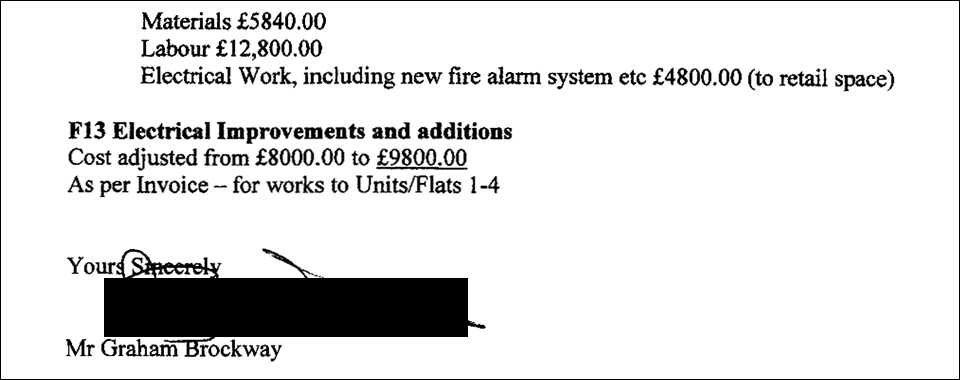
As can be seen the £4,800 was for work to retail space which was eligible for grant aid while F13 was for Units/Flats 1-4 which wasn’t.
Below is an invoice submitted by an electrician for works to “1-4 to rear of Paul Sartori” (29 Dimond Street):

Again, this clearly shows that the work was done to residential property “1-4 rear of Paul Satori (sic)”
This referred to some outbuildings in the back yard which had been converted into four bedsits.
This flies in the face of the FAQs which state “Sometimes property owners carry out residential works at the same time that builders are working on commercial parts of the building but this is entirely at their own cost.“
So, ahead of the audit committee’s site inspection, the council sent one of its own quantity surveyors to inspect the building.
He produced a three page report which sought to put the best possible gloss on things, but even he felt the £4,800 was excessive if restricted to the retail space and couldn’t find any way to justify the £9,800 for the electrical work under the F13 item:
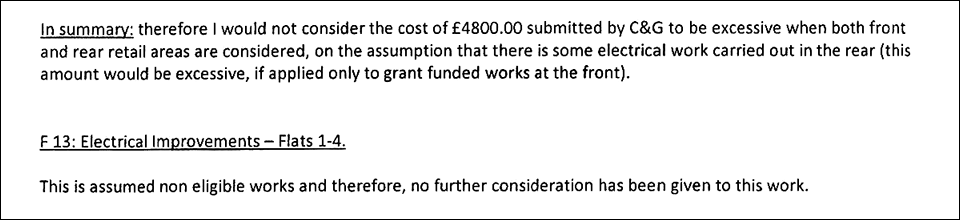
Of course, the assumption that F13 was non eligible works was in accordance with what FAQ document had to say about residential development.
However, there was no need for him to make any assumptions because if he’d taken the trouble to consult the council’s files he would have found that the “Final account grant calculation” for 29 Dimond Street (below) – carried out by staff in the council’s European Office – shows quite clearly that, under F13, the £9,800 had been classified as “eligible” and that a 40% grant of £3,920 had been awarded for this work that should, in the council’s own words, have been carried out “entirely at their [the developer’s] own cost”.
I apologise for the quality of the scans below, but it was on an A3 spreadsheet and this was the best my Pentlepoir-based technical expert could manage.

Perhaps the European Officer should have ensured that he and his staff were following the rules set out in the FAQ document rather than worrying that I might have misunderstood how the system worked.
And the above case is only the tip of a rather large iceberg.
My submission to the police included a spreadsheet that identified some £40,000 in irregular payments on this project alone including E5-21 in the document above which were all for works carried out in the four bedsits.
Indeed, on this one project, there were 40 payments for items that were not eligible for grant aid and nine for work that was never carried out.
Careful inspection of the final account (above) reveals that three of the items that received a 40% grant (E14, 16 and 21) contain the words “(excluding retail space)”.
As the financial assistance was specifically for the refurbishment of retail space, you may wonder how council staff came award them, and the £9,800 for electrical improvements to “Flats 1-4”, a 40% grant.
If the police are correct, and there has been no dishonesty by council staff, then the only conclusion is that there was incompetence on an industrial scale.
And you might also wonder about the report to the audit committee in September 2013 which stated:
“Internal Audit has shared its findings with the Council’s Monitoring Officer who is satisfied that there is no evidence of maladministration or non-compliance with the governance arrangements relevant to the specific schemes or of any lack of competence [my emphasis] in officers concerned with the administration of the scheme.”
Seems to me that whoever wrote this report was either guilty of “lack of competence”, or involved in a cover-up.
No need to tell you which way I am betting.