
The latest revelations about police failures to investigate a Westminster-based paedophile ring demonstrates the Establishment’s ability to look after its own. This will be a phenomenon familiar to readers of this website (Time Lord).
And I could cite several other examples – the most recent of which is the council’s efforts to sweep my concerns about grants in Pembroke Dock under the carpet; graphically illustrated by Cllr David Pugh’s mendacious speech to council on 12 December 2013 (also see Anatomy of a cover-up).
My own experiences with the Commissioner for Local Government in Wales – better known as the Ombudsman – support these criticisms.
Take for instance Cllr Rob Lewis, former deputy leader of PCC and cabinet member for highways, who used his position to unlawfully access the council’s computer system with a view to giving his party, the IPG as it then was, an advantage at both the 2008 and 2012 elections.
While all breaches of the Code of Conduct should be treated seriously, few can be as serious as trying to influence the “free and fair” elections which are the bedrock of any democratic system.
However, having served a puny two-week suspension imposed by what Private Eye referred to as “the amusingly titled “standards committee”,” Cllr Lewis remains in place.
Shortly after the standards committee decided Cllr Lewis’ case, the author of that other website, Cllr David Bryan and myself took a trip up to the council’s electoral office in Goodwick to exercise our statutory right to inspect the election expense returns of Cllr Lewis and several of his IPG colleagues for the 2012 local government elections.
It was there that the three of us made the startling discovery that what Cllr Lewis had told the Ombudsman about the printing of his election leaflets didn’t accord with what he told the Returning Officer on his election expenses return.
It occurred to Old Grumpy that this sort of deception constituted behaviour likely to bring the office of councillor into disrepute in breach of the Code of Conduct, so I complained to the Ombudsman:
“Cllr Rob Lewis recently appeared before the county council’s standards committee to answer a finding by the Ombudsman that he had breached the Code of Conduct by using council computers for party political purposes during both the 2008 and 2012 local elections.
The standards committee upheld the Ombudsman’s findings and suspended Cllr Lewis for two weeks.
The standard committee’s minutes record:
“That Councillor R M Lewis be suspended for two weeks.
That Councillor R M Lewis had been very forthright in his responses but he was a Senior Member of the Council and should have ensured he fully understood the rules.
That the period of the suspension take account of his forthrightness but also the length of time taken to bring this matter to this Hearing; he was interviewed in March 2013 when it was brought to the Ombudsman’s attention in late 2012.”
As can be seen, Cllr Lewis was given credit for his forthrightness.
Subsequent revelations suggest that Cllr Lewis was not as honest and open as the committee seemed to believe.
Below is an extract from the transcript of Cllr Lewis’ interview with the Ombudsman’s investigator:
Interviewer: How many leaflets did you have printed?
Rob Lewis: Lots because I had some done for the…the boundary commission changed the ward, so I ended up with a new part which I hadn’t before which was hence the two separate leaflets.
Interviewer: So who printed?
Rob Lewis: Clive…
Interviewer: Clive James?
Rob Lewis: Clive does the printing.
Interviewer: So would you then pay Clive for the printing?
Rob Lewis: Clive done all the printing, yeah.
Interviewer: How many did you have printed, just roughly?
Rob Lewis: I had two different lots you see, I had two different lots.
Interviewer: Yeah.
Rob Lewis: So I ended up with like, off the top of my head I wouldn’t know, but I’d say 700 of one and 500 of another.
Interviewer: And the cost roughly?
Rob Lewis: Oh…£90 to £100, somewhere around there, I don’t know off the top of my head.”
However, on checking Cllr Lewis’ election expenses return, no sign could be found of any invoice from Mr Clive James.
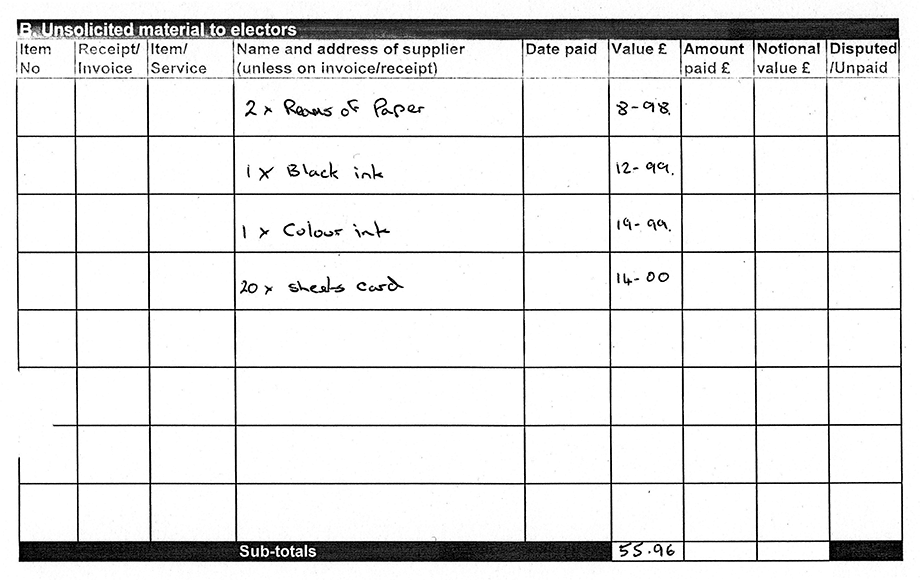
Instead, Cllr Lewis submitted a return (below) in which he claimed to have expended £55.96 on paper and ink cartridges.
Clearly, he lied to either the Ombudsman’s investigator, or the Returning Officer.
This, I submit, constitutes a breach of Para 6(1)a of the Code of Conduct.
Your sincerely.
Mike Stoddart
I received the following reply:

This letter seemed to completely miss the point because the £35 difference between the two versions was irrelevant.
However, when you deal with officialdom on a frequent basis, you come to appreciate its talent for re-framing the question to fit the desired answer.
Despite knowing from experience that such people are very reluctant to change their minds i.e. admit they might have got it wrong, I asked for the case to be reconsidered:
“Thank you for your letter of 29 May regarding my complaint against Cllr Robert Lewis of Pembrokeshire County Council.
I’m afraid the emphasis you put on the approximately £35 discrepancy between the £90 – £100 that Cllr Lewis gave your investigator as the cost of printing his election material and the £55.96 he included on his election expenses return is a straw man.
Cllr Lewis told your investigator that his election leaflets were printed by Mr Clive James who works in the council’s print unit and also runs an entirely separate private printing business. The law requires any single item of election expenditure above £20 to be evidenced by an invoice.
No such invoice accompanied Cllr Lewis’ election return.
Instead, there was a list of costs for paper and ink cartridges (none of which exceeded £20) consistent with him printing the leaflets on his own computer.
Why Cllr Lewis should make this return if his leaflets were indeed printed by Mr James is something of a mystery, but possible explanations include either the wish to conceal the fact that his election material had been printed by a council employee (giving rise to potential issues with regard to member/officer relations), or that this was a cash transaction designed to enable Mr James to evade paying tax.
Alternatively, Cllr Lewis may have printed the election material on his home computer and, when he told the Ombudsman’s investigator that “Clive done all the printing yeah” and that it cost him £90-£100, he wasn’t telling the truth.
So, as a matter of logic, Cllr Lewis either made a false declaration on his election expenses return, or he lied to your investigator.
The fact that the difference between the two versions was a mere £35 is therefore immaterial.
In view of the above, could I ask that the Ombudsman’s review manager reconsider your decision not to investigate my complaint.
Regards
Mike Stoddart
But, as expected, it was all to no avail:

Of course, one of the difficulties for the Ombudsman was that, if he did reopen the investigation, questions might be asked about the thoroughness of the original inquiry.
After all, if a bunch of amateurs like Jacob Williams, David Bryan and me can think to check Rob Lewis’ story by spending less than an hour inspecting his election return, people might wonder why it didn’t occur to the Ombudsman’s full-time, highly-trained professional investigator to do the same.
Alas, as with so many of these cases, the Ombudsman was marking his own exam paper and, not surprisingly, shied away from lumbering himself with a resit.