Recent events on the rugby pitch have persuaded me that it is now safe to abandon the regime of self-imposed silence that I have adopted since February 6 this year.
I actually attended the game in Cardiff on that day and will relish for as long as I live the moment the chap in front of me interrupted his constant barrage of abuse aimed at the referee to turn round and ask me not to sing so loudly.
It was very quiet on the coach back to Haverfordwest and my efforts to enliven things with a rendering of “Swing low” brought no response from my fellow passengers.
Indeed, they were all pretending to be asleep, though I suspect it was because they didn’t know the words.
However, five weeks have passed and the English world-beaters have been transformed into average at best, while Welsh no-hopers now find themselves as contenders for the Six-Nations championship.
There is much talk about Wales’ huge points deficit, but that seems to ignore the other possibility: that England and Ireland both lose their final matches.
And, looking at next weekend’s fixtures, it seems to me that the odds of Wales finishing on the winning side are vastly superior to those of the other two contenders.
Though we shouldn’t rule out the possibility of all three losing with France sticking forty unanswered points on England to walk off with the trophy.
I must admit that, based on historical precedent, I had high hopes of this season’s championship: 1215 Magna Carta; 1415 Agincourt; 1815 Waterloo; and 2015 . . .
I had penciled in “New Grand Slam sweater” but that has now been rubbed out and replaced with “Rugby World Cup winner’s T-shirt”.
In the past, I have complained about the tendency of rugby pundits to write the result rather than the game.
Three things should always be remembered when discussing the Six-Nations: home advantage, the referee and luck.
To win away from home against one of the top four, as Wales and England have done this season is a huge achievement no matter how ugly the methods might be.
With penalties being so important – both in terms of points and yards gained – the referee is easily the most influential man on the field.
What he sees and doesn’t see often has a greater bearing on the result than the relative strength of the teams.
And, well, luck is luck.
No doubt the Wales-Ireland game was the pick of this season’s bunch for sheer commitment and tension, though rugby purists might complain about the lack of fast open rugby.
Warren Gatland was surely right when he described it as “a great Test Match”.
But he was even more on the money when he added “It could have gone either way”.
Indeed, that it might have gone either way was the main reason it was such a great Test Match.
I know people will think this is fanciful, but I have a theory that Wales’ inspired defensive effort in the second half was the result of Gatland’s team talk when he told the players; “Look lads we’ve got to win this to give ourselves even an outside chance of taking the championship, but, even more important, if we let Ireland win, England’s hopes will be gone.”
Of course, we all swing from euphoria to despair depending on the result, but Kipling had it right when he wrote:
If you can meet with Triumph and Disaster
And treat those two imposters just the same.
So here’s looking forward to the weekend, whatever it brings.
Another equally compelling, though less widely reported, contest: the race to become vice-chairman of PCC which brings automatic promotion to the top job for the year 2016-2017, is hotting up.
A mole tells me the two contenders – The Voice of Johnston and Pearl’s the Girl – have been beating a path to the Leader’s door in the hope that the great man’s endorsement will see them over the finishing line.
However, with just a single seat majority, the Leader is reluctant to cause offence by taking sides.
It rather reminds me of the priest who visited Voltaire on his deathbed and urged him to renounce the Devil.
“Nay, man,” Voltaire replied, “this is no time to be making new enemies.”
There was a time long ago when anyone with ambitions to be chairman simply found a proposer and a seconder and entered the election at the council’s annual meeting in May.
That all proved to be rather too democratic for the then Leader of the IPG Maurice Hughes and when, in 2000, three of his loyal followers expressed an interest in the chain he decided to organise a postal ballot.
At this distance in time, it is hardly worth mentioning that the council’s franking machine and envelopes were pressed into service and a council officer was detailed off to run the election.
The three contenders in what I dubbed the Chainbearer Stakes were Cllrs Pat Griffiths, Rosemary Hayes and George Grey.
As I recall all attracted double-figure support on the first ballot, but Cllr Griffiths in third place was eliminated and a second postal ballot was arranged in which Cllr Hayes recorded a narrow victory.
With the 39 IPG votes behind her, it was pointless for the opposition to field a candidate and Cllr Hayes had a walk-over.
Of course, if all three had put their names forward at the annual meeting, it is quite possible that opposition votes would have delivered a different result.
But it would also mean that the chairmanship was not in the gift of the IPG leadership.
Since then the IPG/IPPG has usually managed to settle on a single candidate at one of its secret group meetings and thanks to its block vote the group’s monopoly of the chairmanship has been comfortably maintained.
Post the 2012 election, when its majority was reduced to 33-27 (now 31-29) the ruling group has bolstered its numbers by persuading a couple of “useful idiots” from the opposition benches to propose and second its chosen candidate.
And so it is that the chairmanship and vice-chairmanship, which should be non-political, have become part of the vast web of patronage that serves to maintain the Leader and his cronies in power.
Another use to which the chain has been put is as a departure lounge for Cabinet members and committee chairmen who have passed their sell-by date.
So, in order to provide a soft landing, the chairmanship, which is time-limited, is used as a parachute for those who have been discarded.
Cllrs Anne Hughes, Bill Roberts, Peter Morgan, Arwyn Williams and the present incumbent – former planning committee chairman Tom Richards – have all passed this way.
In the case of the two latest candidates, Cllr Pearl Llewellyn surrendered the chairmanship of the licensing committee (SRA £9,000) without a fight in 2014 on the understanding that the leadership would see to it that she would inherit the chain, while Ken Rowlands; still smarting from being unceremoniously kicked out of the Cabinet (SRA £15,000), also needs to be kept sweet.
In order to square this circle, I am told, the IPPG is to organise a hustings where both runners will be able to parade their talents in order to assist the rest of the group to make up their minds.
Various titles have been suggested for this process: Hex Factor, Pembrokeshire’s got talent, The Great Kremlin fake-off, Donqui Derby, among them.
But I have to give credit to the young whippersnapper for coming up with “Universally Challenged”.
I understand there are some mischief-makers among the opposition (no names, no pack drill) who are encouraging Pearl to stand whatever the outcome of the IPPG’s beauty contest.
The calculation is that, in a secret ballot, the terrifying prospect of The Voice booming out from the chairman’s seat will swing it in her favour.
On my list of ambitions, becoming chairman of the county council comes some way below being marooned on a desert island with only Brian Hall and Johnny Allen-Mirehouse for company.
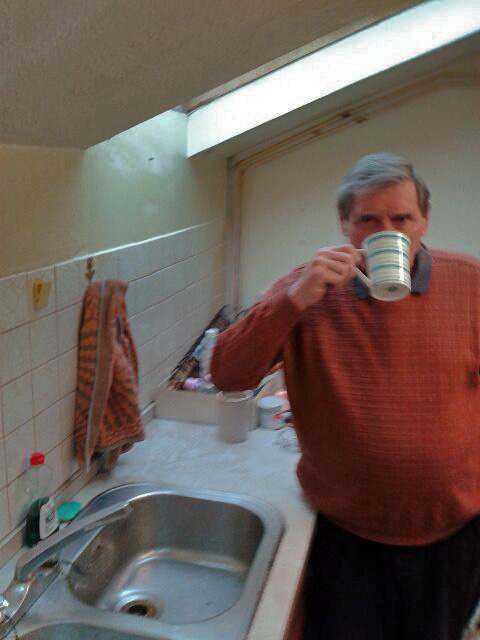
However, should I have a change of heart, I understand the professionals think that showing that “we’re all in this together” by having your photo taken sipping tea in the kitchen (the smaller and scruffier the better) is a sure-fire vote-winner.
So here is picture-proof of the Spartan conditions at Grumpy Towers.